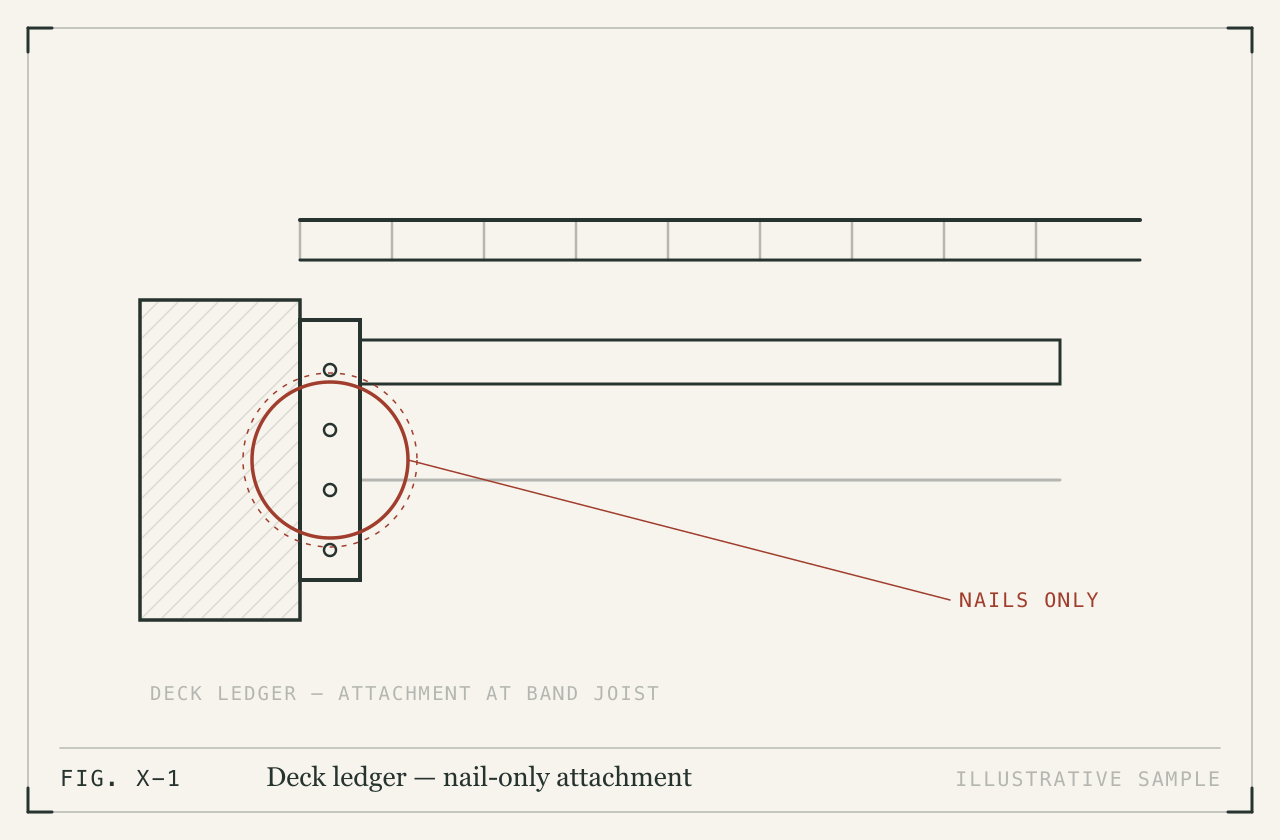
 Safety attentionTerrace deck ledger relies on nail-only attachmentRear terrace at kitchen levelHave a qualified contractor retrofit the ledger with properly spaced structural fasteners and add ledger flashing. Until the attachment is verified, avoid concentrated gatherings on the terrace.
Sample report — a fictional property, produced by the real SightSpec pipeline.
Your property report
Final9 Crest Hollow Lane
Longmeadow, MA, 01106
May 8, 2026 · Inspected by Sam Stone
Inspection record 5,480 ft² · 5 bd / 5 ba · Built 2016
- Inspected
- May 8, 2026
- Inspector
- Sam Stone
- Prepared for
- Elena Marsh
- Property
- 5,480 ft² · 5 bd / 5 ba · Built 2016
- Coverage
- 6 of 6 systems inspected
At a glance
Start with the one safety item — it's in Exterior & Site.
The rest is planning: two major defects, three routine items and five notes, each documented with the evidence below.
- 1Safety attention1 needs attention before closing
- 2Major defect2 to plan and budget for
- 3Repair & maintenance3 routine repair and upkeep items
- 5Informational5 notes for your records
- 6 of 6Systems inspected
- 3Photos
Planning ranges across 3 of 6 findings: $4,200 – $16,425 · rough ranges, not contractor quotes
Important findings
The three findings to read first — the full record follows below.
Safety attentionTerrace deck ledger relies on nail-only attachmentRear terrace at kitchen levelHave a qualified contractor retrofit the ledger with properly spaced structural fasteners and add ledger flashing. Until the attachment is verified, avoid concentrated gatherings on the terrace.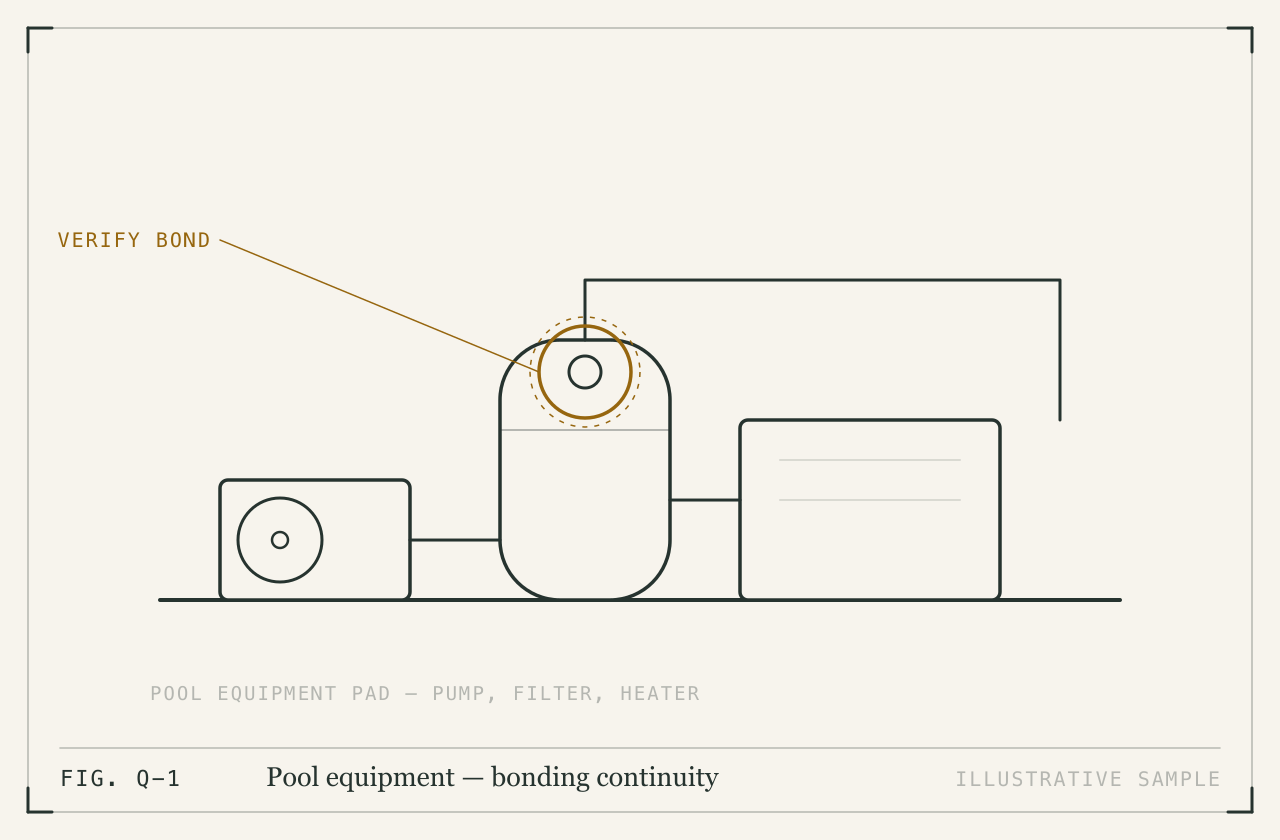 Major defectEquipment bonding continuity could not be verifiedPool equipment padHave a licensed electrician reconnect the bonding conductor and verify continuity of the bonding grid across all pool equipment. Bonding is the system that keeps every touchable metal surface at the same electrical potential — it protects swimmers, and it must be intact.
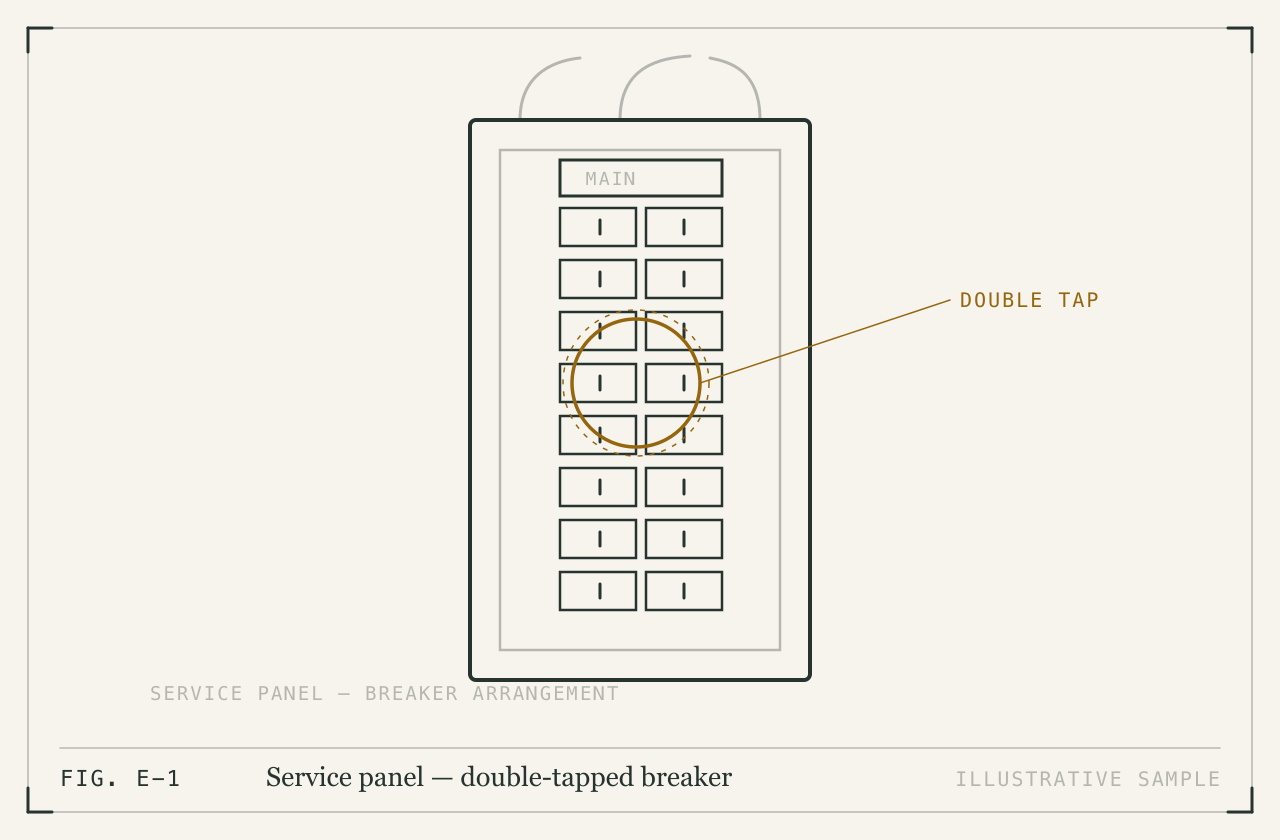 Major defectDouble-tapped breaker in the garage subpanelGarage subpanelHave an electrician move one conductor to its own breaker. A single open position remains in this subpanel, so the correction is straightforward.
Action summary
Every item that needs attention
All 6 actionable findings, grouped by consequence. Tap any item for its photos and full detail.
Significant Repair Items
2
- Equipment bonding continuity could not be verifiedHave a licensed electrician reconnect the bonding conductor and verify continuity of the bonding grid across all pool equipment.Pool equipment pad · Pool & Spa
- Double-tapped breaker in the garage subpanelHave an electrician move one conductor to its own breaker.Garage subpanel · Electrical
Recommended Repairs & Maintenance
3
- Wine-room condensate routed to a concealed wall cavityReroute the condensate line to a serviceable termination with an air gap, or add a float switch that shuts the unit down if the drain backs up.Lower level, wine room · Heating & Cooling
- Tankless water-heater cascade documented; descaling dueSchedule descaling service and return to an annual cycle to protect the heat exchangers and preserve the warranty.Mechanical room · Plumbing
- Irrigation backflow preventer test dueHave the backflow assembly tested and tagged for the current season.Basement, irrigation manifold · Plumbing
A repair is complete when it can be verified — keep contractor receipts, and your inspector can re-check any item at a re-inspection.
Systems at a glance
- Exterior & Site1Safety attention1Informational
- Pool & Spa1Major defect1Informational
- Electrical1Major defect1Informational
- Heating & Cooling1Repair & maintenance1Informational
- Plumbing2Repair & maintenance
- Interior1Informational
1 section not applicable to this property — see Scope & limitations.
Legend: ▲ Safety attention · ◆ Major defect · ● Repair & maintenance · ○ Informational
Inspection details
- Address
- 9 Crest Hollow Lane
- Inspection date
- May 8, 2026
- Inspector
- Sam Stone
- Client
- Elena Marsh
- Year built
- 2016
- Square footage
- 5,480 sq ft
Meet your inspector
Sam Stone
Summit Home Inspections
I'm Sam Stone, and Summit Home Inspections is my one-inspector company here in Springfield. I walk every home the same way — top to bottom, slowly, with a camera in hand — because the report you're reading is the product you paid for.
My job on inspection day is to notice things; my job afterward is to make sure you understand them. If anything in this report is unclear, call or email me. Explaining a finding is always part of the service, never an extra.
From your inspector
Thanks for trusting me with your inspection. This report is organized so the most serious items come first — start at the top and work down.
Every finding carries a photo, what I observed, and what I'd recommend. Nothing in here is meant to alarm you: every home has a list, and knowing yours is how you stay ahead of it.
If anything is unclear, call or email me — walking clients through their report is part of the job.
Sam Stone
Exterior & Site
1Safety attention 1Informational
One safety item and one note were recorded in this system.
01.1
Terrace deck ledger relies on nail-only attachment
Safety attentionRear terrace at kitchen levelBefore closingGeneral contractor
What we observed
The elevated rear terrace's ledger board is attached to the band joist with nails only — no lag screws or through-bolts were visible at the accessible portion, and no ledger flashing was observed above it. Ledger attachment is the most common failure point in elevated deck collapses, and this terrace stands over a walk-out patio.
Recommended
Have a qualified contractor retrofit the ledger with properly spaced structural fasteners and add ledger flashing. Until the attachment is verified, avoid concentrated gatherings on the terrace.Planning range: $1,000 – $8,150 — Roof / flashing repair, including potential underlayment work. Not a contractor quote.
01.2
Stone and fiber-cement cladding transitions well executed
InformationalAll elevations
Reference image — not this property

What we observed
Cladding transitions, kick-out flashings, and window head details are executed to a high standard, with consistent sealant joints and proper clearances to grade. Recorded as a baseline for future maintenance.
Recommended
No action needed — reseal joints on a normal five-to-seven-year cycle.
Pool & Spa
1Major defect 1Informational
One major defect and one note were recorded in this system.
02.1
Equipment bonding continuity could not be verified
Major defectPool equipment padNear-termElectrician
What we observed
The pool equipment pad is orderly and the pump, filter, and heater all operated normally. However, the bonding conductor at the heater's bonding lug was disconnected, and continuity of the equipotential bonding grid could not be verified by visual inspection.
Recommended
Have a licensed electrician reconnect the bonding conductor and verify continuity of the bonding grid across all pool equipment. Bonding is the system that keeps every touchable metal surface at the same electrical potential — it protects swimmers, and it must be intact.
02.2
Safety cover anchors and barrier compliance documented
InformationalPool deck
Reference image — not this property

What we observed
The automatic safety cover operated properly, deck anchors are secure, and the barrier gates self-close and self-latch as required.
Recommended
No action needed — retained for the record.
Electrical
1Major defect 1Informational
One major defect and one note were recorded in this system.
03.1
Double-tapped breaker in the garage subpanel
Major defectGarage subpanelNear-termElectrician
In plain terms — Double-tapping means two wires share a terminal. Whether that connection is permitted depends on the terminal's rating.
What we observed
One breaker in the garage subpanel serves two conductors under a single lug — likely added when the EV charging circuit was installed. The breaker is not listed for two conductors, and this connection point can loosen and overheat over time.
Recommended
Have an electrician move one conductor to its own breaker. A single open position remains in this subpanel, so the correction is straightforward.Planning range: $1,800 – $4,500 — Electrical panel repair or replacement and corrective wiring. Not a contractor quote.
03.2
Standby generator and transfer switch documented
InformationalSide yard; basement transfer switch
What we observed
The standby generator started on its scheduled exercise cycle during the inspection and the automatic transfer switch is properly labeled. Service records show annual maintenance.
Recommended
No action needed — continue the existing service contract.
Heating & Cooling
1Repair & maintenance 1Informational
One routine item and one note were recorded in this system.
Home age 10 years · typically 10–20 years (furnace 15–20, central A/C 10–15)
04.1
Wine-room condensate routed to a concealed wall cavity
Repair & maintenanceLower level, wine roomNear-termHandyman
Reference image — not this property

What we observed
The wine room's dedicated cooling unit drains its condensate into a concealed wall cavity rather than to a visible, serviceable termination. No moisture was detected in the adjacent finishes at the time of inspection, but a blocked concealed drain would announce itself as hidden damage first.
Recommended
Reroute the condensate line to a serviceable termination with an air gap, or add a float switch that shuts the unit down if the drain backs up.
04.2
Dual-zone systems balanced and serviced
InformationalMechanical room; attic air handler
What we observed
Both heating/cooling systems operated normally with appropriate temperature differentials at supply registers. Service tags are current, condensate management includes float protection at the attic air handler, and zoning dampers responded to thermostat calls.
Recommended
No action needed — continue semi-annual service.
Plumbing
2Repair & maintenance
Two routine items were recorded in this system.
05.1
Tankless water-heater cascade documented; descaling due
Repair & maintenanceMechanical roomNear-termPlumber
Reference image — not this property

What we observed
Two condensing tankless water heaters operate as a cascade with proper isolation valves. Service tags show the last descaling was over two years ago; the manufacturer recommends annual descaling in this water hardness region.
Recommended
Schedule descaling service and return to an annual cycle to protect the heat exchangers and preserve the warranty.Planning range: $1,400 – $3,800 — National typical installed range, 2026; a local quote governs — tank-type replacement. Not a contractor quote.
05.2
Irrigation backflow preventer test due
Repair & maintenanceBasement, irrigation manifoldPlumber
What we observed
The irrigation system's backflow preventer carries a test tag from two seasons ago; most jurisdictions require annual testing.
Recommended
Have the backflow assembly tested and tagged for the current season.
Interior
1Informational
One note was recorded in this system.
06.1
Interior finishes, doors, and hardware at a high standard
InformationalThroughout
Reference image — not this property
What we observed
Interior finishes are consistent with a custom build of this caliber: doors latch and swing true, cabinetry is well fitted, and stone surfaces are properly sealed. Baseline documented for your records.
Recommended
No action needed — retained for the record.
Your maintenance timeline
Findings mapped onto a simple calendar — what to handle now and what can wait.
Now
1Terrace deck ledger relies on nail-only attachment
Next 30 days
2Equipment bonding continuity could not be verified
Double-tapped breaker in the garage subpanel
This year
3Wine-room condensate routed to a concealed wall cavity
Tankless water-heater cascade documented; descaling due
Irrigation backflow preventer test due
Ongoing upkeep
5Stone and fiber-cement cladding transitions well executed
Safety cover anchors and barrier compliance documented
Standby generator and transfer switch documented
Dual-zone systems balanced and serviced
Interior finishes, doors, and hardware at a high standard
Scope & limitations
6 of 6 systems inspected
Every accessible system on this property was inspected. The full roster is below for your records.
- Exterior & SiteInspected
- Pool & SpaInspected
- ElectricalInspected
- Heating & CoolingInspected
- PlumbingInspected
- InteriorInspected
- Guest HouseNot applicable
Legend: ▲ Safety attention · ◆ Major defect · ● Repair & maintenance · ○ Informational
System service life
Home age 10 years · built 2016
Heating & cooling equipment
typically 10–20 years (furnace 15–20, central A/C 10–15)
Marker = home age (10 yrs) · band = typical range · documented in the Heating & Cooling chapter of this report
Planning information only — not a prediction, a warranty, or a component age. Typical ranges follow InterNACHI's Standard Estimated Life Expectancy Chart; actual life varies with climate, material, and maintenance, and components may have been replaced since the home was built.
Inspection photographs
3 photographs on file
Representative views of the systems inspected without a finding. Every photograph of a finding sits beside that finding; the full record stays on file with this report.
Every photograph on file documents a finding above.
Repair request summary
A prioritized list to support your conversation with the seller. Tick the items you want to raise, then copy the list for your agent. Full photos and context for each item are in the report.
Safety Items to Address
1 itemMajor Repairs to Negotiate
2 itemsRecommended Maintenance
3 itemsPrepared from the SightSpec inspection report to support a conversation with the seller. Items are summarized from the report, which contains the full photographs and context. This is not legal advice and does not change the contents of the underlying report.
Appendix
Guidance and programs from your inspector — kept after the record so the findings stay first.
11Homeowner resourcesOpen ▸Close ▾
This report is a record of what was visible and accessible on the day of the inspection. It is organized by system — roof, structure, electrical, plumbing, heating and cooling, and the rest of the home — so you can read it front to back or jump straight to the part you care about.
Start with the summary. It names what matters most and links to the detail. Then read the chapters for the systems you plan to use, repair, or budget for. Photographs sit beside the findings they belong to, so you can see exactly what the inspector saw.
Every finding carries one of the following severities. They mean the same thing on every SightSpec report, and each is always written out by name, so the meaning survives any printout:
No report can describe a home perfectly, and no inspection is a warranty. Where a system could not be fully examined, the report says so plainly rather than staying silent. If a finding is unclear, ask your inspector — this report is theirs, and explaining it is part of the work you paid for.
Safety attention — A condition that could affect someone's safety — have it evaluated before closing.
Major defect — A significant repair or system concern — plan and budget for it.
Repair & maintenance — Routine repair or upkeep — normal for any home.
Informational — Worth knowing — no action implied.
About this report
Your maintenance calendar: Now · 1 — Next 30 days · 2 — This year · 3 — Ongoing upkeep · 5 · See the full timeline