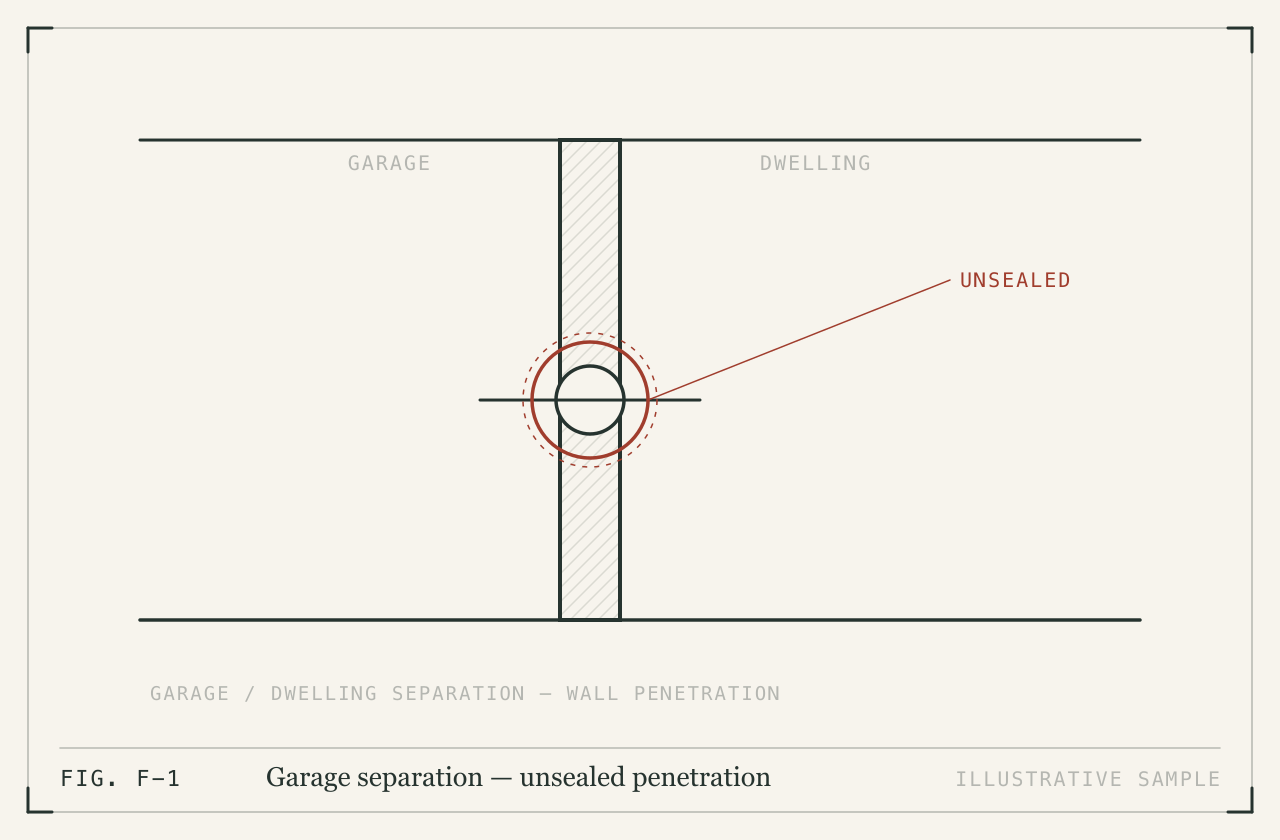
 Safety attentionUnsealed penetration in the garage/dwelling separationGarage, wall to utility roomBuilder item: seal the penetration with an approved fire-rated sealant before closing. Verify at the completion walkthrough.
Sample report — a fictional property, produced by the real SightSpec pipeline.
Your property report
Final118 Fieldstone Way
Wilbraham, MA, 01095
June 19, 2026 · Inspected by Sam Stone
Inspection record 2,740 ft² · 4 bd / 3 ba · Built 2026
- Inspected
- June 19, 2026
- Inspector
- Sam Stone
- Prepared for
- Marcus Webb
- Property
- 2,740 ft² · 4 bd / 3 ba · Built 2026
- Coverage
- 7 of 7 systems inspected
At a glance
Start with the one safety item — it's in Garage.
The rest is planning: one major defect, seven routine items and four notes, each documented with the evidence below.
- 1Safety attention1 needs attention before closing
- 1Major defect1 to plan and budget for
- 7Repair & maintenance7 routine repair and upkeep items
- 4Informational4 notes for your records
- 7 of 7Systems inspected
- 3Photos
Planning ranges across 2 of 9 findings: $390 – $2,270 · rough ranges, not contractor quotes
Important findings
The three findings to read first — the full record follows below.
Safety attentionUnsealed penetration in the garage/dwelling separationGarage, wall to utility roomBuilder item: seal the penetration with an approved fire-rated sealant before closing. Verify at the completion walkthrough.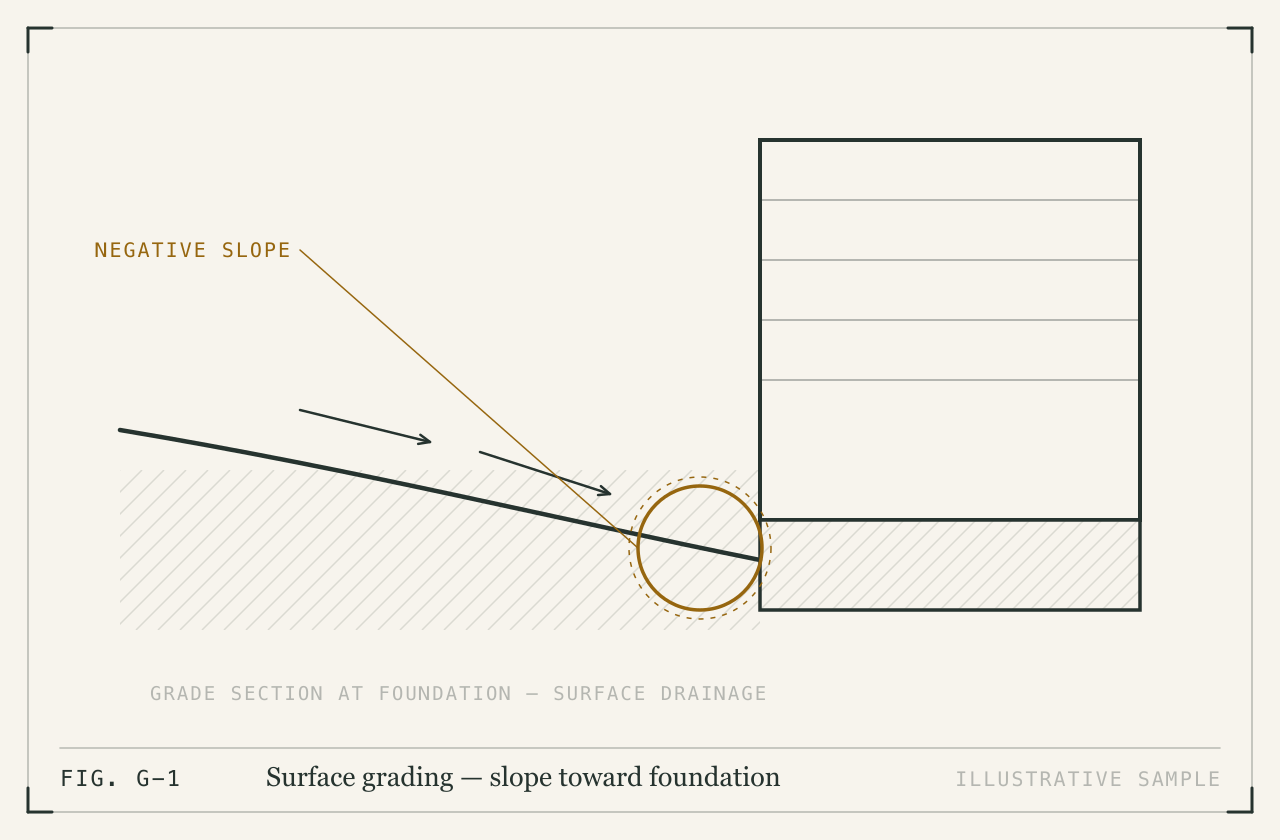 Major defectFinal grade slopes toward the foundation at the rear patioRear elevation at patioBuilder item: complete final grading to fall away from the foundation and confirm the swale between lots carries water to the street. Re-check after the first heavy rain and again at the eleven-month warranty walkthrough.
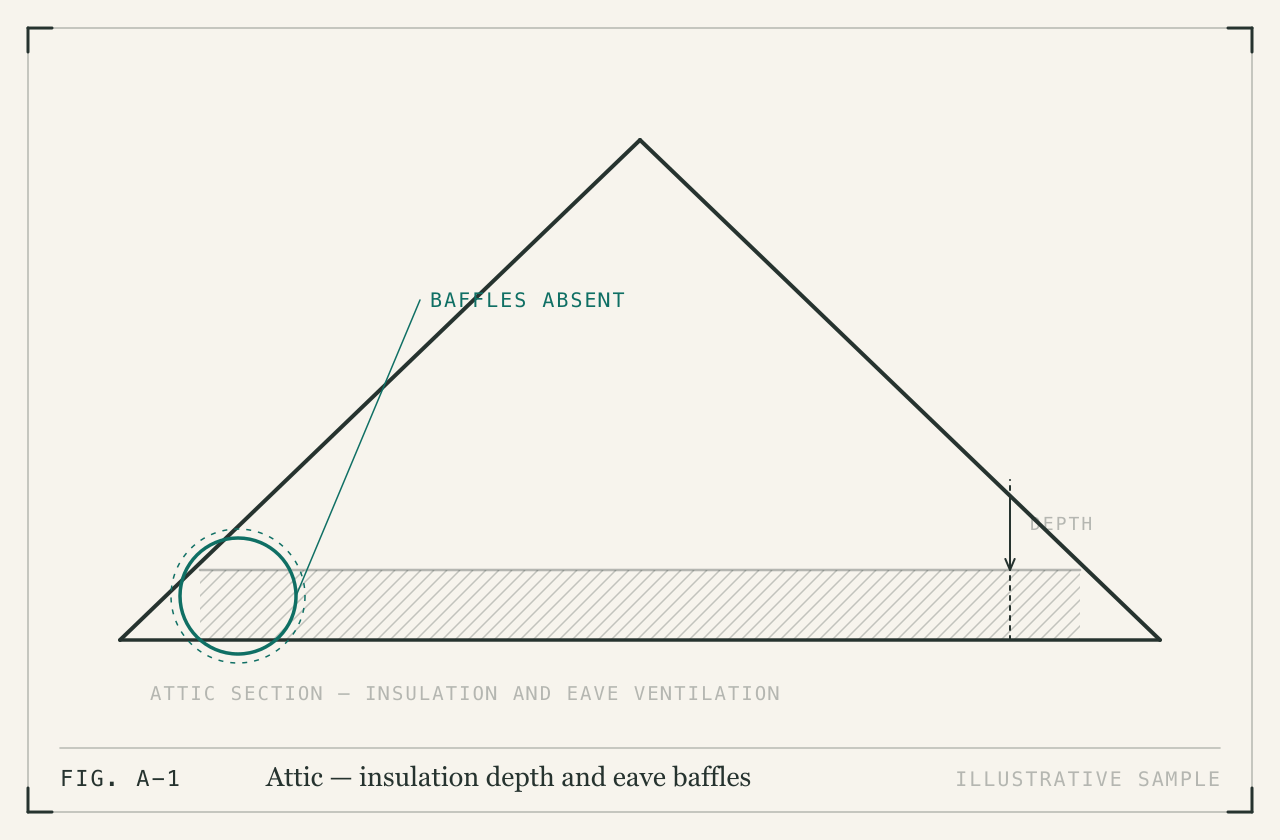 Repair & maintenanceInsulation baffles missing at four eave baysAttic, north eaveBuilder item: install baffles at the four affected bays and redistribute the insulation.
Action summary
Every item that needs attention
All 9 actionable findings, grouped by consequence. Tap any item for its photos and full detail.
Health & Life Safety
1
Recommended Repairs & Maintenance
7
- Insulation baffles missing at four eave baysBuilder item: install baffles at the four affected bays and redistribute the insulation.Attic, north eave · Attic & Insulation
- Siding penetrations for utilities not fully sealedBuilder item: seal both penetrations with an approved exterior sealant.Right elevation, near meter · Exterior & Site
- Downspout extensions not yet installedBuilder item: install extensions carrying discharge at least six feet from the foundation.All corners · Exterior & Site
- Drywall nail pops and corner-bead cracking — first-year settlement setDocument with the builder and repair at the eleven-month warranty walkthrough, after the structure completes its first full seasonal cycle.Stairwell; primary bedroom ceiling · Interior Finish
- Two interior doors rub their framesBuilder item: adjust hinges/strikes so both doors close and latch cleanly.Bedroom 3; hall bathroom · Interior Finish
- AFCI/GFCI protection verified; two cover plates missingBuilder item: install the missing cover plates.Basement, two locations · Electrical
- Supply airflow imbalance at two second-floor roomsBuilder item: have the HVAC installer balance the system so all rooms condition evenly.Bedrooms 3 and 4 · Heating & Cooling
A repair is complete when it can be verified — keep contractor receipts, and your inspector can re-check any item at a re-inspection.
Systems at a glance
- Garage1Safety attention1Informational
- Exterior & Site1Major defect2Repair & maintenance
- Interior Finish2Repair & maintenance1Informational
- Attic & Insulation1Repair & maintenance
- Plumbing2Informational
- Electrical1Repair & maintenance
- Heating & Cooling1Repair & maintenance
1 section not applicable to this property — see Scope & limitations.
Legend: ▲ Safety attention · ◆ Major defect · ● Repair & maintenance · ○ Informational
Inspection details
- Address
- 118 Fieldstone Way
- Inspection date
- June 19, 2026
- Inspector
- Sam Stone
- Client
- Marcus Webb
- Year built
- 2026
- Square footage
- 2,740 sq ft
Meet your inspector
Sam Stone
Summit Home Inspections
I'm Sam Stone, and Summit Home Inspections is my one-inspector company here in Springfield. I walk every home the same way — top to bottom, slowly, with a camera in hand — because the report you're reading is the product you paid for.
My job on inspection day is to notice things; my job afterward is to make sure you understand them. If anything in this report is unclear, call or email me. Explaining a finding is always part of the service, never an extra.
From your inspector
Thanks for trusting me with your inspection. This report is organized so the most serious items come first — start at the top and work down.
Every finding carries a photo, what I observed, and what I'd recommend. Nothing in here is meant to alarm you: every home has a list, and knowing yours is how you stay ahead of it.
If anything is unclear, call or email me — walking clients through their report is part of the job.
Sam Stone
Garage
1Safety attention 1Informational
One safety item and one note were recorded in this system.
01.1
Unsealed penetration in the garage/dwelling separation
Safety attentionGarage, wall to utility roomBefore closingRoofer
What we observed
A conduit penetration through the garage-to-dwelling separation wall is not fire-sealed. The separation wall is the assembly that slows a garage fire from reaching the living space, and every penetration through it must be sealed with an approved material.
Recommended
Builder item: seal the penetration with an approved fire-rated sealant before closing. Verify at the completion walkthrough.
01.2
Overhead door and opener operate correctly
Informational
Reference image — not this property

What we observed
Both safety-reverse mechanisms functioned properly and the door tracks are plumb and secure.
Recommended
No action needed — retained for the record.
Exterior & Site
1Major defect 2Repair & maintenance
One major defect and two routine items were recorded in this system.
02.1
Final grade slopes toward the foundation at the rear patio
Major defectRear elevation at patioNear-termFoundation contractor
What we observed
Final grading was not complete at the time of inspection: along the rear patio the grade currently directs runoff toward the foundation. New-construction backfill also settles over the first seasons, which will make this worse before it makes it better.
Recommended
Builder item: complete final grading to fall away from the foundation and confirm the swale between lots carries water to the street. Re-check after the first heavy rain and again at the eleven-month warranty walkthrough.
02.2
Siding penetrations for utilities not fully sealed
Repair & maintenanceRight elevation, near meterNear-termRoofer
Reference image — not this property

What we observed
Two utility penetrations through the fiber-cement siding lack sealant collars, leaving small gaps into the wall assembly.
Recommended
Builder item: seal both penetrations with an approved exterior sealant.
02.3
Downspout extensions not yet installed
Repair & maintenanceAll cornersNear-termRoofer
Reference image — not this property
In plain terms — Gutters collect roof runoff; downspouts carry that water to a discharge point.
What we observed
Downspouts currently discharge at the foundation; extensions or drains were not yet installed.
Recommended
Builder item: install extensions carrying discharge at least six feet from the foundation.Planning range: $240 – $1,900 — Re-grading or drainage correction around the foundation. Not a contractor quote.
Interior Finish
2Repair & maintenance 1Informational
Two routine items and one note were recorded in this system.
03.1
Drywall nail pops and corner-bead cracking — first-year settlement set
Repair & maintenanceStairwell; primary bedroom ceilingStructural engineer
Reference image — not this property

What we observed
Scattered drywall nail pops and one hairline corner-bead crack were noted — ordinary first-year settlement items in new construction, listed here so they enter the builder's warranty record now.
Recommended
Document with the builder and repair at the eleven-month warranty walkthrough, after the structure completes its first full seasonal cycle.
03.2
Two interior doors rub their frames
Repair & maintenanceBedroom 3; hall bathroomHandyman
Reference image — not this property
What we observed
Two doors rub at the latch side of their frames and do not latch smoothly.
Recommended
Builder item: adjust hinges/strikes so both doors close and latch cleanly.
03.3
Window hardware complete and operable throughout
InformationalThroughout
Reference image — not this property
What we observed
All accessible windows opened, closed, locked, and tilted properly; screens are present and undamaged.
Recommended
No action needed — retained for the record.
Attic & Insulation
1Repair & maintenance
One routine item was recorded in this system.
04.1
Insulation baffles missing at four eave bays
Repair & maintenanceAttic, north eaveNear-termGeneral contractor
In plain terms — The eave is the roof overhang; the soffit covers its underside and fascia finishes its outer edge.
What we observed
Four eave bays on the north side lack ventilation baffles, and blown insulation is blocking soffit airflow at those bays. The remainder of the attic meets the insulation specification on the builder's certificate.
Recommended
Builder item: install baffles at the four affected bays and redistribute the insulation.
Electrical
1Repair & maintenance
One routine item was recorded in this system.
05.1
AFCI/GFCI protection verified; two cover plates missing
Repair & maintenanceBasement, two locationsElectrician
Reference image — not this property

What we observed
Arc-fault and ground-fault protection tested correctly throughout. Two receptacle cover plates in the unfinished basement are not yet installed.
Recommended
Builder item: install the missing cover plates.Planning range: $150 – $350 — National typical installed range, 2026; a local quote governs — per receptacle. Not a contractor quote.
Heating & Cooling
1Repair & maintenance
One routine item was recorded in this system.
Home age 0 years · typically 10–20 years (furnace 15–20, central A/C 10–15)
06.1
Supply airflow imbalance at two second-floor rooms
Repair & maintenanceBedrooms 3 and 4Handyman
Reference image — not this property
What we observed
During cooling operation, supply airflow at bedrooms 3 and 4 measured noticeably weaker than the rest of the second floor, suggesting dampers need balancing.
Recommended
Builder item: have the HVAC installer balance the system so all rooms condition evenly.
Plumbing
2Informational
Two notes were recorded in this system.
Home age 0 years · typically 7–12 years
07.1
All fixtures functional; water heater commissioning verified
InformationalThroughout
Reference image — not this property

In plain terms — A water heater supplies heated water. Its temperature-and-pressure relief valve provides a release path for excessive temperature or pressure.
What we observed
Functional flow and drainage verified at every fixture; no leaks observed at accessible connections; the water heater's installation, expansion tank, and TPR discharge are correct.
Recommended
No action needed — retained for the record.
07.2
Exterior hose bibs not yet tested — supply valved off
InformationalBoth exterior hose bibs
Reference image — not this property
What we observed
Both exterior hose bibs were valved off at interior stops, so they could not be functionally tested.
Recommended
Ask the builder to open the supplies and verify both bibs at the completion walkthrough.
Your maintenance timeline
Findings mapped onto a simple calendar — what to handle now and what can wait.
Now
1Unsealed penetration in the garage/dwelling separation
Next 30 days
1Final grade slopes toward the foundation at the rear patio
This year
7Siding penetrations for utilities not fully sealed
Downspout extensions not yet installed
Drywall nail pops and corner-bead cracking — first-year settlement set
Two interior doors rub their frames
Insulation baffles missing at four eave bays
AFCI/GFCI protection verified; two cover plates missing
Supply airflow imbalance at two second-floor rooms
Ongoing upkeep
4Overhead door and opener operate correctly
Window hardware complete and operable throughout
All fixtures functional; water heater commissioning verified
Exterior hose bibs not yet tested — supply valved off
Scope & limitations
7 of 7 systems inspected
Every accessible system on this property was inspected. The full roster is below for your records.
- GarageInspected
- Exterior & SiteInspected
- Interior FinishInspected
- Attic & InsulationInspected
- PlumbingInspected
- ElectricalInspected
- Heating & CoolingInspected
- Landscaping & IrrigationNot applicable
Legend: ▲ Safety attention · ◆ Major defect · ● Repair & maintenance · ○ Informational
System service life
Home age 0 years · built 2026
Heating & cooling equipment
typically 10–20 years (furnace 15–20, central A/C 10–15)
Marker = home age (0 yrs) · band = typical range · documented in the Heating & Cooling chapter of this report
Water heater (tank)
typically 7–12 years
Marker = home age (0 yrs) · band = typical range · noted by the inspector in this report
Planning information only — not a prediction, a warranty, or a component age. Typical ranges follow InterNACHI's Standard Estimated Life Expectancy Chart; actual life varies with climate, material, and maintenance, and components may have been replaced since the home was built.
Inspection photographs
3 photographs on file
Representative views of the systems inspected without a finding. Every photograph of a finding sits beside that finding; the full record stays on file with this report.
Every photograph on file documents a finding above.
Repair request summary
A prioritized list to support your conversation with the seller. Tick the items you want to raise, then copy the list for your agent. Full photos and context for each item are in the report.
Safety Items to Address
1 itemMajor Repairs to Negotiate
1 itemRecommended Maintenance
7 itemsPrepared from the SightSpec inspection report to support a conversation with the seller. Items are summarized from the report, which contains the full photographs and context. This is not legal advice and does not change the contents of the underlying report.
Appendix
Guidance and programs from your inspector — kept after the record so the findings stay first.
12Homeowner resourcesOpen ▸Close ▾
This report is a record of what was visible and accessible on the day of the inspection. It is organized by system — roof, structure, electrical, plumbing, heating and cooling, and the rest of the home — so you can read it front to back or jump straight to the part you care about.
Start with the summary. It names what matters most and links to the detail. Then read the chapters for the systems you plan to use, repair, or budget for. Photographs sit beside the findings they belong to, so you can see exactly what the inspector saw.
Every finding carries one of the following severities. They mean the same thing on every SightSpec report, and each is always written out by name, so the meaning survives any printout:
No report can describe a home perfectly, and no inspection is a warranty. Where a system could not be fully examined, the report says so plainly rather than staying silent. If a finding is unclear, ask your inspector — this report is theirs, and explaining it is part of the work you paid for.
Safety attention — A condition that could affect someone's safety — have it evaluated before closing.
Major defect — A significant repair or system concern — plan and budget for it.
Repair & maintenance — Routine repair or upkeep — normal for any home.
Informational — Worth knowing — no action implied.
About this report
Your maintenance calendar: Now · 1 — Next 30 days · 1 — This year · 7 — Ongoing upkeep · 4 · See the full timeline